First jobs.

My son recently asked me about my first job. What was it, and what did I do?
I had two part time jobs before I got my first job in radio.
My first real paying job was when I was about 12 or 13 and we lived on a small farm near Ellendale, DE. Mom and Dad both worked, so during the summer I was pretty much left alone to fend for myself. My routine was sleeping til mid morning, then I’d watch some TV (Leave it to Beaver, My Favorite Martian, Hazel, Dick VanDyke) and eat cereal and goof off outside until late afternoon. I’d ride my bike, take it apart and pretend I knew how to work on it, and sometimes I would hang out with my friend Joe Guerin, who lived about a mile away. He really knew how to work on bikes.
Mom always left me a list of chores, and I generally would wait until the last second to do them before she got home. Since she worked for the state (Dept of Transportation), her schedule was routine and she always got home at the same time. Dad was managing the hog farm and selling Purina Feeds and artificially inseminating cows, so I never knew when he was coming home.
One day our neighbor, Elwood Tucker, asked me if I wanted a job. He paid me a dollar an hour to walk behind his viner with a pitchfork and pick up the lima beans that the machine missed. I threw them into the hopper where they were automatically shelled. I guess I did ok at that because the following year he added me to the straw and hay bailing crew.
An older guy would drive the truck through the field and I was part of the crew that picked up the bales and threw them onto the trailer. There was another guy on the trailer that grabbed the bales as we threw them, and he stacked them. Straw was light, and a pretty easy job. Hay was heavy, especially if it had any moisture in it, and I struggled to get the bales on the trailer. Sometimes they felt like they had a cinder block hidden inside, and I’d have to spin in a 360 to get the bale on the trailer.
Elwood actually taught me how to drive when I was 13.
He put me on a small tractor first. Then he let me drive his pickup, and eventually the larger farm trucks, across the fields when we were working. I learned how to use a clutch and shift gears, even though I could barely see over the dash.
My second first job would have been working at Clyde Betts and Son. I got the job because that is where Dad worked and Ronnie Mitchell was my boss. He was the best. No interview or skills test. He knew me since I was born - I called him Uncle Ronnie.
I was probably around 15 when I started there, working summers and some Saturdays. My first role there was working in the egg room. I helped grade the eggs. They had thousands of laying hens and Russell Walls and Jason Winstead would bring cases and cases of eggs up to the egg room every morning.
Rick Betts and I would bring them from the cooler on a dolly, three cases at a time. Each case had 30 dozen eggs that were on square flats that held two and a half dozen. We used a big suction contraption to lift the eggs from the flat onto a conveyor belt. They slowly moved down the conveyor through the wash machine to the candling tent.
There the person who operated the grading machine stood, foot on the pedal that started and stopped the grader, staring at the eggs as they went by. There was a bright light under the eggs so you could see through them. The person running the machine had to look at each egg and make sure there were no blood spots inside the eggs, and no cracks to the shell. Blood spots were tossed into a barrel and discarded. Cracks were put onto a separate flat and sold at a discounted price. When they had new flocks, we also had to pull off the double yolks and they were sold at a premium.
From there the conveyor belt took the eggs onto a scale that kicked them off depending on their size/weight. We had small, medium, large, and extra large. They rolled down onto rubber mats where one or two people stood, picking them up and putting them into cartons or back onto flats (for wholesale to restaurants).
Today the process is almost completely automated. But back then, it took three people, minimum, to run the grader and I did all three jobs. We all did. I got really fast at picking them up and putting them into cartons and flats. I could pick up three in each hand, and drop them pointed-end down, into the cartons, close the lid and put them in a 30-dozen box in a couple of seconds. It’s amazing how muscle memory works. Everybody that worked there did this with very little effort, and no broken eggs.
Sometimes they’d send me back to the chicken houses and I had to help pick up the eggs. They had a couple of old chicken houses where we walked in with the hens, and went from laying box to laying box, pulling out the freshly laid eggs. Sometimes the hens would be in the boxes, sitting on the eggs and we had to reach under them and take the eggs. They normally weren’t happy about that and they’d peck at us.
Other times, in the old house, there would be black snakes in the boxes. More than once I reached in for an egg and touched a snake. The houses were dark, and dirty, and loud, and the smell was awful. The air was thick with dust and feathers. In the summer, when you were sweaty, the feathers would stick to your arms and shirt. Perhaps you can tell that I hated that part of the job.
They had other houses that were newer, and getting to the eggs there was much easier. The hens laid the eggs in the boxes but they had a false bottom and the eggs would roll down to the bottom of a rack and we’d just walk down the aisle picking up all the eggs. There was no contact with the chickens, and it was a much cleaner environment. I don’t think I ever saw a snake in there either.
After I got my driver’s license Uncle Ronnie made me a delivery driver. I delivered eggs to Milford on one day, and then delivered to Rehoboth/Lewes one or two days a week. It was generally one day per week except during the summer when we needed to go down two days. I drove a big van and it was usually packed to the roof with cases of eggs. I would get all the order slips, plan my route, and then load the truck in reverse order so that my first stop was loaded last, and closest to the door.
The restaurants in Rehoboth were the hardest because in the summer there weren’t places to park. I put the cases (30 dozen each) onto a dolly and walked into the kitchens to the coolers and unloaded the eggs into a spot designated for eggs. I always had to rotate them too, as a service to the restaurant. In other words, I would take the oldest eggs out, put the fresh eggs in, then put the older eggs on top so they would get used first.
The restaurant kitchens were crazy. Hot, hectic, loud, and generally not as clean as you would think. But I enjoyed doing the deliveries, especially because it got me out of the chicken house.
There was one stop I always dreaded. The Robin Hood restaurant on Rehoboth Avenue was out biggest customer during the tourist season. They served a mind-boggling number of breakfasts and went through cases of eggs like crazy. The owner was also the cook, and every time I showed up with his delivery, he would yell at me, “Rotate! You rotate!”
And it was like I couldn’t move fast enough for him. He wanted me out of his kitchen. But his cooler was always packed, and sometimes they’d store stuff on top of the eggs and I had to move food around to get to the eggs so I could rotate them, and he stressed me out. He was the best at cracking eggs though. I’d watch him pick up four eggs, two in each hand, crack them in one fluid motion, and drop them into separate pans for omelets, and toss the shells into a trash can…all without looking. He was too busy looking at me to make sure I rotated his eggs.
Eventually I started delivering feed too. The bags were 50 lbs and often I had to take them to weird places. One farm near Lewes had a crazy bull and the barn where the feed went was inside the fence, so I had to always find the bull and make sure there was enough time for me to get the feed to the barn before the bull could get to me. He was an ornery rascal. I barely weighed 100 lbs so I bet it was an hilarious sight watching me schlep these heavy bags of feed all over the place.
Clyde Betts & Son also had a hardware store, and I helped out there sometimes. I learned how to mix paint, cut glass and screens, and operate a cash register.
My third first job was at WJWL-WSEA in Georgetown. I suppose I could have just started here and left out the part time jobs. I was going to Delaware Tech studying Journalism in 1976 and thinking I wanted to be a newspaper reporter. After working part time at the News Journal, and writing obits and covering budget hearings at the Sussex County Council, I realized I really didn’t want to do that. I told my professor I wanted to try broadcast journalism instead of print journalism, and that led to an internship at the radio stations.
I would go in a few days a week and work with their news director. When they needed a board operator to work weekends, they offered the job to me. I started working Sundays on the AM station. It was a “daytimer” which meant it was licensed to only operate during the daylight hours. AM signals do weird things at night, so most AM’s have to sign off at sunset. So I worked sunrise to sunset on Sunday’s, mostly playing religious programs that were sent to us via reel to reel tape. A few were live and I would run the controls while the guys preached or whatever.
There were times when I played music and read live ads, and got to be a real DJ. We played mostly 45 rpm records so I learned how to cue them up so they didn’t wah at the beginning. Commercials were either read live, or they were recorded onto carts. Carts (short for cartridges) looked like 8-track tapes, if you remember those. They came in various lengths and automatically cued themselves back up after they played.
That led to doing a Saturday shift as a DJ and eventually, when I graduated from Del Tech, resulted in an offer of a full time job as news director. I was planning to attend Del Tech for two years and then go to the University of Delaware, but the job offer derailed those plans. I had been working part time with the news director, partly as an intern and partly paid, and his decision to leave coincided with my graduation and I had a decision to make: Get a job doing what I want to do right now, or go to college for two more years and then hope I could get a job doing what I want to do. (In hindsight, I would have skipped the job offer and finished my degree. Although experience is generally more important, not having a Bachelor’s degree has been a minor issue with opportunities.)
My boss was Ed Marzoa. He was the guy who put the radio stations on the air for the Rollins family (wealthy upstate family) and he was the general manager. He offered me $95 a week, with no benefits, to generate and deliver the newscasts on the AM, and to fill in as a DJ on the FM rock station as needed.
Ed was a crusty ex-Army WWII vet and he rarely spoke to me. I worked the morning shift, doing news every half hour on the Bob Smith morning show from 6-9 am. He always said, “Wake up in style, with a great big smile…this is Smitty on the radio!” I had listened to him growing up, and it was a great honor to work with him.
At 9, Bob left to go sell advertising, and Ed came into the studio to do a two-way talk show called The Hotline. It was a hugely popular show in the area, and Ed loved arguing with his callers about everything. I was impressed with how he knew enough about every topic to discuss it.
I worked at WJWL/WSEA for about a year. Shortly after starting as news director, I was covering the Delaware State Legislature in Dover and I met a reporter from an AM station in Newark named Meg McDonald. She was, like me, a one-man band trying to cover the news of the entire state by herself. We cooked up an idea that we would share audio versions of one story a day with each other to make our operations sound bigger, and to add some variety to the newscasts. So every morning around 5:45 we would call and feed a story to each other. For instance, I would read a story I had written and I would tag it by saying “Bill Sammons in Dover, for WNRK news”. And she would do the same for me, ending with “I’m Meg McDonald in Wilmington for WJWL news.”
It sounded great and our listeners thought we had bigger news departments. Meg eventually was offered a job at WILM, an all-news radio station in Wilmington and our arrangement had to end. But before she even started, she told me they were looking for a male voice to anchor mornings at WILM, and she put in a good word for me. Their news director, Drew Angeline, called and asked me if I could come up for an interview, and I followed Meg to WILM. Two years later, Meg left for WBOC AM/FM/TV in Salisbury, and the exact same thing happened. She found out they were looking for a male voice to do news and I went down for an interview and got the job. She was a real talent and ended up anchoring the news at the number one TV station in Charlotte, and then anchoring at Channel 10 in Philadelphia.
Me…I stayed in Delaware.
Some times I ride by the Tucker Farm and the fields seem so much smaller than they did when I was following the bean viner or bailing hay. Elwood was the best first boss I could have hoped for. He was a hard worker and expected the same out of me. He was just a nice human being with a warm smile. I always felt as though he liked me. Maybe he did, or maybe he just tolerated me, but what a great boss/employee relationship…when you respect your boss and you know he values you.
I also learned a lot from Uncle Ronnie. He somehow put up with having Rick and I work together for several years. There was a lot of joking and laughter, and he let us have our fun, but he also made sure we got the job done, and that we did it right. I do remember him separating us one day, saying, “You boys working together is like having half a person.”
Ed Marzoa gave me my first break in a career that I have loved for almost 5 decades. I mentioned that he was crusty and rarely spoke to me, and I was actually afraid of him. But I remember one day when he came to work early. Bob and I were there around 5am to prepare for the morning broadcast, and Ed would come in by 8. But on this morning he was there around 6 and he shut the door to his office. A little while later I heard him in the bathroom next to the studio, and he was getting sick to his stomach.
Bob confided in me. “Ed has to fire somebody today, and it’s hard on him.”
That was the day I realized Ed had a heart and his gruff exterior hid his compassion. There were times during my career when I was in a similar position. Letting someone go is the hardest thing an employer has to do. I’d remember Ed, and how it affected him, and for some reason it helped me.
Every job, every experience, every person along the way helped shape me into being a better employee…and hopefully a better leader.
“Leadership is not about being in charge. It is about taking care of those in your charge.”
— Simon Sinek
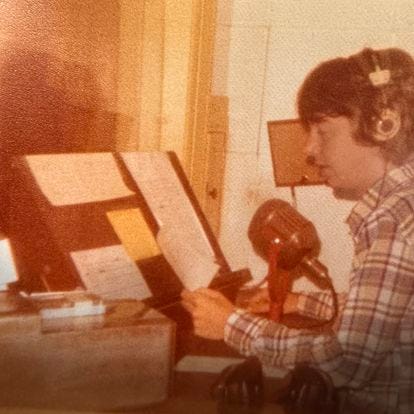
Photo from 1978. I was 21 and anchoring mornings at WILM Newsradio in Wilmington, DE.
I think I’m related to Elwood Tucker, he had a brother named Atwood. I love finding connections!